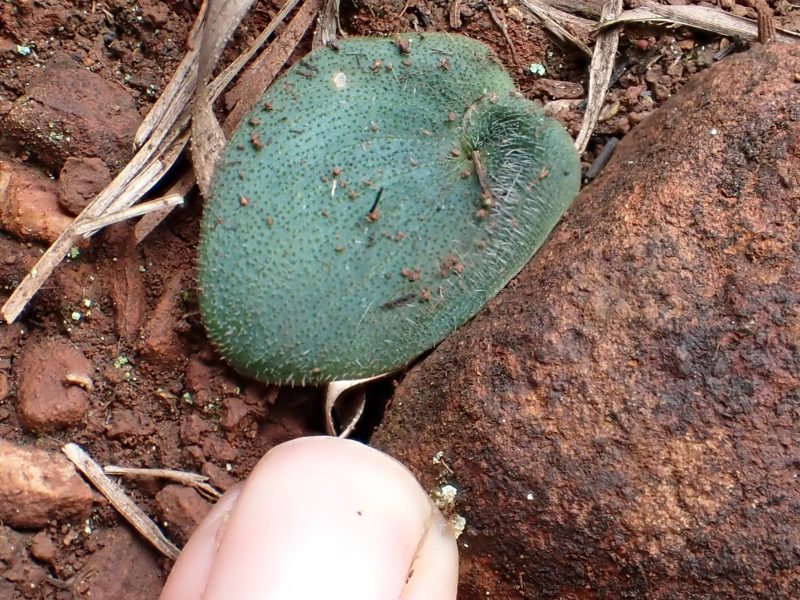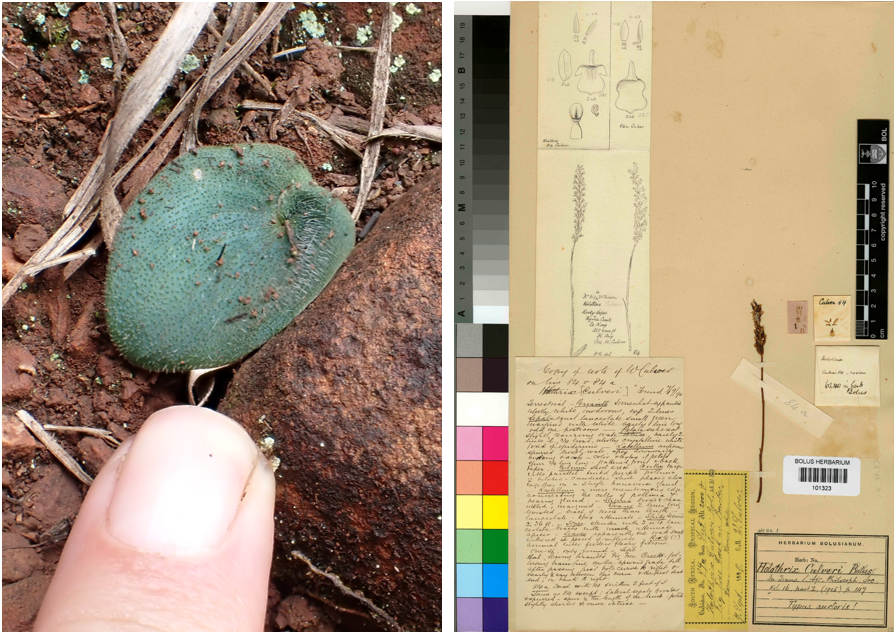
The leaf (Photo: Delia Oosthuizen) and type specimen of Holothrix culveri. (Source: Global Plants)
In the world of botany, some species don’t just grow; they haunt the landscape. Holothrix culveri, a tiny, terrestrial orchid with a penchant for the ancient soils of Mpumalanga, is one such ghost.
First recorded in 1890 and lost to science for over a century, its story is a rollercoaster of discovery, destruction, and a narrow, flickering hope for survival. The story begins in 1886. W. Culver, a correspondent for the legendary botanist Harry Bolus, arrived in Barberton via ox-wagon. On September 7, 1890, Culver stumbled upon two specimens of a curious orchid.
His field notes described a location near Fig Tree Creek following a tramline. And that would become a treasure map for future generations. Based on Culver’s find, Harry Bolus described the species in 1905—and then, the trail went cold.
For 116 years, Holothrix culveri vanished. While the botanical world held onto the pressed specimen in the Bolus Herbarium, the world outside changed. The tramline was replaced, and eventually, a road was built directly over the spot where Culver once stood.
Between 2002 and 2006, the Mpumalanga Plant Specialist Group (PSG) launched repeated searches. In February 2006, Shane Burns finally spotted a leaf. It was the first sign of life in over a century, but the species remained “lost” in a functional sense—it was present, but its survival was hanging by a thread.
What makes H. culveri so special isn’t just its rarity, but its home. It is endemic to the Barberton Centre of Plant Endemism, tucked between the jagged outcrops of the Barberton Greenstone Belt. These rocks are among the oldest on Earth (some over 3.5 billion years old), providing a prehistoric backdrop for one of the world’s most modern extinction crises.
In August 2021, the PSG returned to the site but found nothing. Then, in December of that year, I was lucky to find a single leaf on an embankment in Mountainlands Nature Reserve.
But the discovery was bittersweet: The good news was that it was found more than 3 km away from the original type locality and at a higher altitude. This proves the orchid isn’t confined to one doomed roadside and has a wider range than we thought. The bad news was that before the plant could flower—the only way to 100% confirm its identity—the soil on the embankment gave way, and the plant disappeared. Or did it?
Holothrix culveri (from the Greek holos for “whole” and thrix for “hair”) is a perennial geophyte. It spends much of its life as a dormant tuber underground, waiting for the right moment to send up its hairy stalk and star-like flowers. Like most Holothrix, this species features one or two round leaves that lay perfectly flat against the ground—a beautiful adaptation that unfortunately makes them very easy to accidentally step on.
Classified as Critically Endangered, Holothrix culveri occupies a precarious position, with its original locality increasingly fragmented by infrastructure, mining, and urban sprawl. The species’ survival hung in the balance until the singular, fortuitous photograph of a leaf revealed its presence within Mountainlands. This vital expansion of its known range offers a rare reprieve for the orchid; the next milestone is the discovery of a specimen in full bloom.