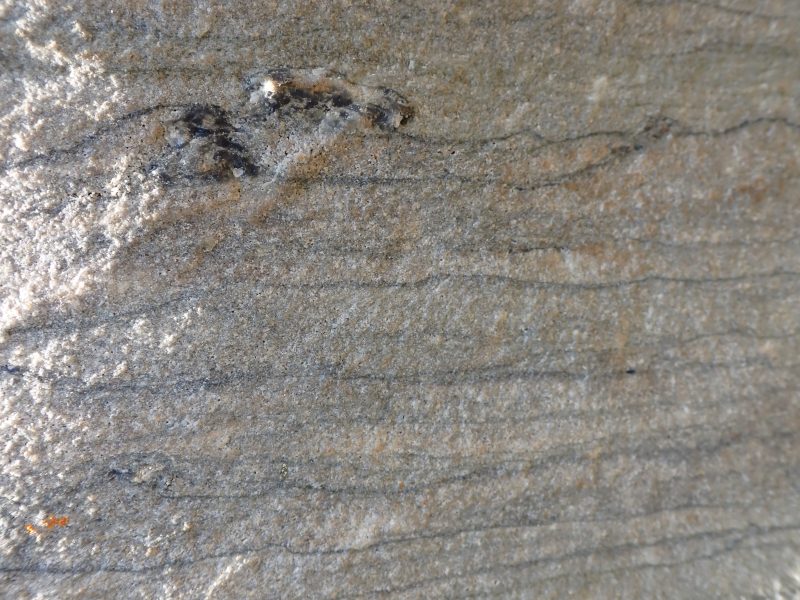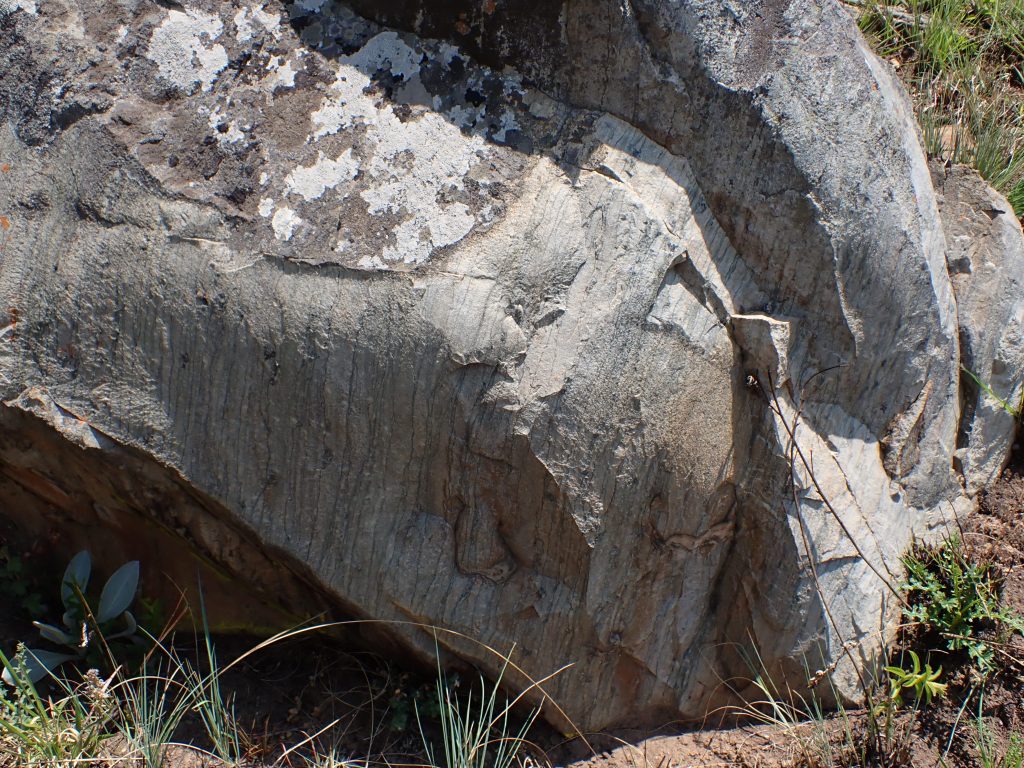
See those darker crinkly layers? Those are fossilized microbial mats from the Moodies Group.
Imagine standing on a beach 3.2 billion years ago. The air is thick and filled with greenhouse gasses, the sun is dimmer, the sky orange and the sea greenish, there are no plants, no animals, and not a single insect. But look closer at the sand beneath your feet, and you’ll see something incredible: a miniature, living landscape pulsing with rhythm. New research has unlocked the secrets of these ancient microbes that acted as the world’s first landscape architects—and their 3-billion-year-old work is still visible today.
The Moodies Group, is the uppermost and youngest geological unit of what is known as the Barberton Supergroup in the Barberton Greenstone Belt (BGB). This geological formation dates back 3.2 billion years and contains some of the oldest and best preserved sedimentary and tidal deposits on Earth. These rocks contain “fossilized carpets” of ancient bacteria (microbial mats) that lived in shallow water 3.22 billion years ago. Visible to the naked eye, the ancient rocks of the Moodies Group show strange, crinkly, and “tufted” patterns—small peaks and ridges that look like tiny mountain ranges in the sand. While researchers knew these mats existed, it was unclear exactly how they formed their unique shapes and how the microbes interacted with the sand beneath them.
A team of international researchers from the University of Wyoming (USA), Texas, A & M University (USA), Blue Marke Space Institute of Science (USA), Amentum (UK),Southern University of Science and Technology (China) and the Friedrich-Schiller-Universität (Germany) wanted to answer the question of how these tiny microbes created such complex, tough and organized structures that could resist being washed away by tides during the formation years of the young Earth. They have recently published their findings in “Sedimentology”, the journal of the International Association of Sedimentologists in a paper titled: “A photosynthetic, socially motile lifestyle 3.22 billion years ago: Evidence from fossilised tufted microbial mats.”
To solve this mystery, the researchers grew modern versions of these microbes—a type of cyanobacteria called Leptolyngbya—in a laboratory, using strains found today in the hot springs of Yellowstone National Park. They placed them on quartz sand similar to the ancient environment and filmed their behaviour using time-lapse photography.
What the study found was remarkable behaviour: During the day, thousands of tiny microbial filaments moved together, forming mobile bundles that “swarmed” across the sand. The microbes also responded to light; they were active and bundled together during the day to maximize photosynthesis, but they slowed down and partially spread out at night. Their movement appeared to be coordinated through physical touch.
The most surprising finding was that these tiny organisms actually reshaped the physical landscape around them. As the microbial bundles moved, they exerted force on the sand grains, essentially “rolling” them into piles. The microbes preferentially moved larger grains of sand toward the centers of their tufts. The grain-sorting patterns found in the laboratory were nearly identical to those seen in the 3.22-billion-year-old fossils. This strongly suggests that the ancient structures were formed by the same type of active, social behaviour.
This research pushes back the timeline for “social” behaviour in bacteria to over 3.2 billion years ago. It shows that even the earliest life forms on Earth were capable of coordinated movement and sensing their environment to survive. Furthermore, because these microbes left behind such specific “fingerprints” in the sand (the sorted grain patterns), scientists can now use these as biosignatures. These are recognizable patterns that could help us find evidence of ancient life on other planets, like Mars, where similar sandy environments once existed.
Source for the original publication:
https://onlinelibrary.wiley.com/doi/10.1111/sed.70116