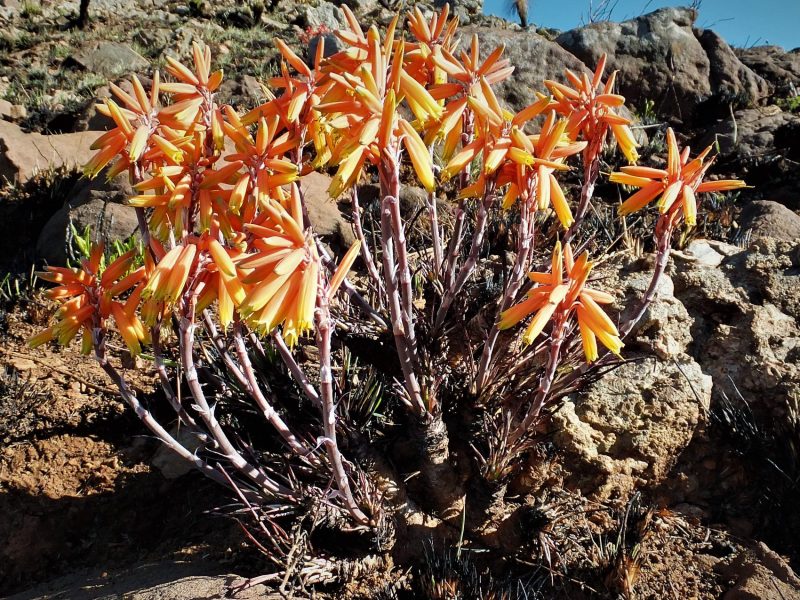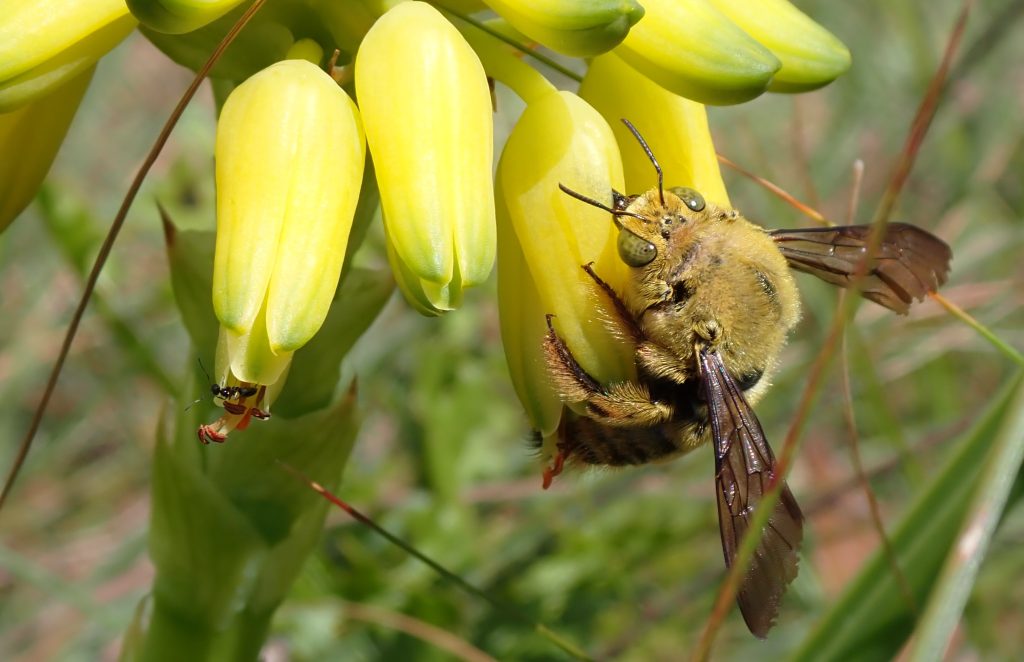
A carpenter bee on an Aloe craibii flower.
High on the grassland ridges of Mountainlands Nature Reserve, a quiet evolutionary drama plays out among rare and understudied grass aloes. Unlike their massive, tree-like cousins that dominate more arid grass- and scrubland, grass aloes (Aloe sections Graminialoes and Leptoaloe) are slender, herbaceous succulents that spend most of the year hidden among tall mountain grasses. When fire or spring rains arrive, these threatened endemics erupt into vibrant blooms.
This hidden mountain world recently took centre stage at the University of the Witwatersrand (Wits), where researcher Verona Govender officially graduated with her PhD. Her thesis, Floral Factors Influencing Pollinator Visitation and Efficacy in Selected Species of Grass Aloes, and the Role of Colour in Pollinator-Driven Diversification in Aloes, explores the intricate relationships between these rare succulents, their pollinators, and the evolutionary power of flower colour. Warm congratulations go to Dr. Govender, her supervisor, Emeritus Professor Glynis Goodman-Cron, and her co-supervisor, Professor Ed Witkowski, on this outstanding achievement.

From left: Prof Ed Witkowski, Dr. Verona Govender and Emeritus Prof Glynis Goodman-Cron
For Dr. Govender, uncovering these ecological secrets required years of hands-on, unpredictable work in the field alongside expert collaborators. “Fieldwork gave me a deeply personal connection to nature I don’t think I could have found anywhere else, like the day I got to capture and measure bird pollinators alongside bird ringer Don Williamson,” Dr. Govender reflected. “As someone who likes everything planned, the toughest part was the unpredictability of it all, never quite knowing when you’d need to be in the field or what the outcome of lab work would be. Looking back, that unpredictability shaped the experience just as much as the highlights did.”
It is precisely this multi-year research conducted on Mountainlands that has uncovered crucial ecological dynamics driving these species. The findings challenge long-held assumptions about plant survival, floral colours, and pollination in fire-prone grasslands – offering essential lessons for land managers, farmers, and conservationists.
For decades, botanists assumed these modest succulents followed the simple, established rules of flower biology: birds pollinate red flowers, bees pollinate yellow ones, and bright displays are an absolute win for attracting life. But Dr. Govender’s ground-breaking field research reveals a far more complex, wilder story. In the rugged expanses of Mountainlands, grass aloes live on a delicate evolutionary tightrope – balancing fire-triggered survival, shifting pollinator loyalties, and a devastating, hidden appetite from predatory insects.
Walk into a patch of Aloe chortolirioides var. chortolirioides in full bloom, and you will immediately notice something striking: no two flowers look quite identical. In a single hillside population, blossoms can range from brilliant fire-engine red to fiery orange and glowing sunny yellow.
What keeps this vibrant spectrum alive in the same soil? Dr. Govender’s research ruled out soil chemistry and microclimates – the soil composition, pH, and local weather were virtually identical across different colour patches. Instead, the secret driver turned out to be wildfire.
In these high-altitude grasslands, fire acts as an active ecological conductor rather than just a force of destruction. When wildfires sweep through the nature reserve, scorching dry vegetation, red-flowered grass aloes respond with a synchronized explosion of blooms. This mass flowering creates an unmistakable beacon across the charred black landscape.
Crucially, high-resolution spectral and microscopic testing revealed that these flowers aren’t operating on simple “red vs. yellow” genetic light switches. Instead, grass aloes mix their colours along a continuous chemical gradient, carefully dialling up or down concentrations of red anthocyanins and yellow-orange carotenoid pigments.
Being the brightest, most dazzling flower on a burnt hillside seems like a brilliant strategy for attracting pollinators. But in nature, visual flair comes with a deadly tax.
Dr. Govender’s field data uncovered an unexpected evolutionary trade-off: the most visually conspicuous, brilliant floral displays suffered catastrophic rates of pre-dispersal fruit and seed predation. Small, hungry wasps zero in on these eye-catching flower patches just as eagerly as pollinators do, in hopes to provide the perfect home for their larvae.
Once inside the developing seed pods, these tiny seed predators devour the nutritious future generations of aloes before they can ever drop to the soil or catch the wind. For critically rare species like Aloe albida (vulnerable) and Aloe craibii (endangered), as well as A. chortolirioides (near threatened), this unseen insect feast creates a severe reproductive bottleneck. While a plant might look triumphantly successful while in full bloom, its actual yield of viable, surviving seeds can be slashed to a tiny fraction by hidden seed eaters.
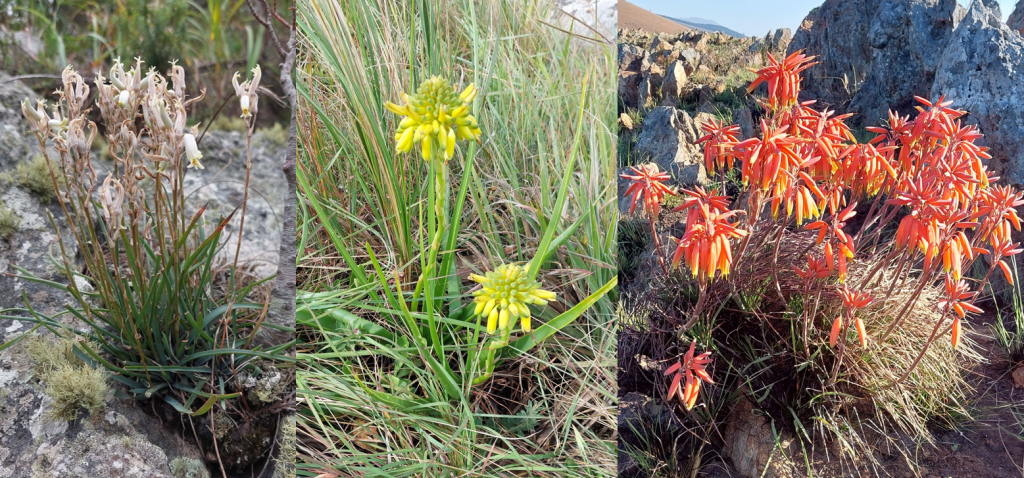
From left: Aloe albida, Aloe craibii and Aloe chortolirioides.
Textbooks often teach that flowers fit neat “pollination syndromes” – tubular red flowers belong exclusively to nectar-loving sunbirds, while smaller, paler flowers belong to bees. The grass aloes completely rewrite this rigid rulebook.
Dr. Govender tracked pollinator visits across multiple seasons and discovered a remarkably flexible, bimodal pollination system. In some years, shimmering malachite and double-collared sunbirds were the primary visitors, darting from stem to stem. In other years, the birds were scarce, and native solitary and honeybees stepped up to perform the heavy lifting of pollination.
Moreover, smaller species like Aloe albida and Aloe craibii were proven to rely almost entirely on native bee species for successful seed set. Furthermore, when visiting multicolour patches of Aloe chortolirioides, pollinators demonstrated strong “flower constancy”- individual bees and birds repeatedly chose to stick with red blossoms during a single foraging trip, helping maintain distinct genetic lineages within a shared hillside.
Zooming out from local mountain slopes to deep evolutionary history across millions of years, Dr. Govender tested whether these dramatic flower colour changes were the engine driving the creation of new species across the broader Aloe family tree.
The evolutionary modelling produced a surprising answer: No.
While flower colour in aloes changes frequently across evolutionary time – flipping back and forth between red, orange, and yellow with immense evolutionary lability – these colour shifts do not trigger faster rates of speciation or lineage diversification. Instead, red pigment states persist far longer across deep time because anthocyanins do double duty: they aren’t just visual billboards for birds, but powerful chemical shields against intense high-altitude solar radiation and environmental stress.
These discoveries provide vital, actionable intelligence for conservation managers protecting biodiversity hotspots like Mountainlands Nature Reserve: Reserve managers cannot treat fire as an unpredictable disaster or suppress it entirely. Controlled, well-timed burns are essential to trigger flowering synchrony and maintain colour diversity in grass aloe populations.
Health assessments of rare plant populations must look past counting open flowers. Conservationists must inspect seed pods for internal insect damage to measure true reproductive output. Saving rare grass aloes requires protecting their full ecological network – from ground-nesting native bee habitats to the nectar-rich corridors used by nomadic sunbirds.
By listening to the complex stories told by these unassuming mountain succulents, science gains a clearer map for ensuring their survival – keeping the high grasslands vibrant, wild, and blooming for generations to come.