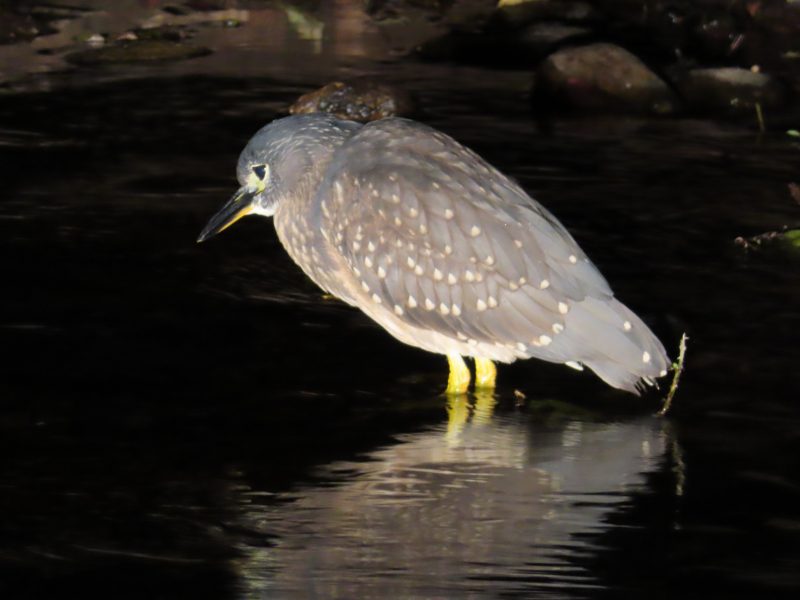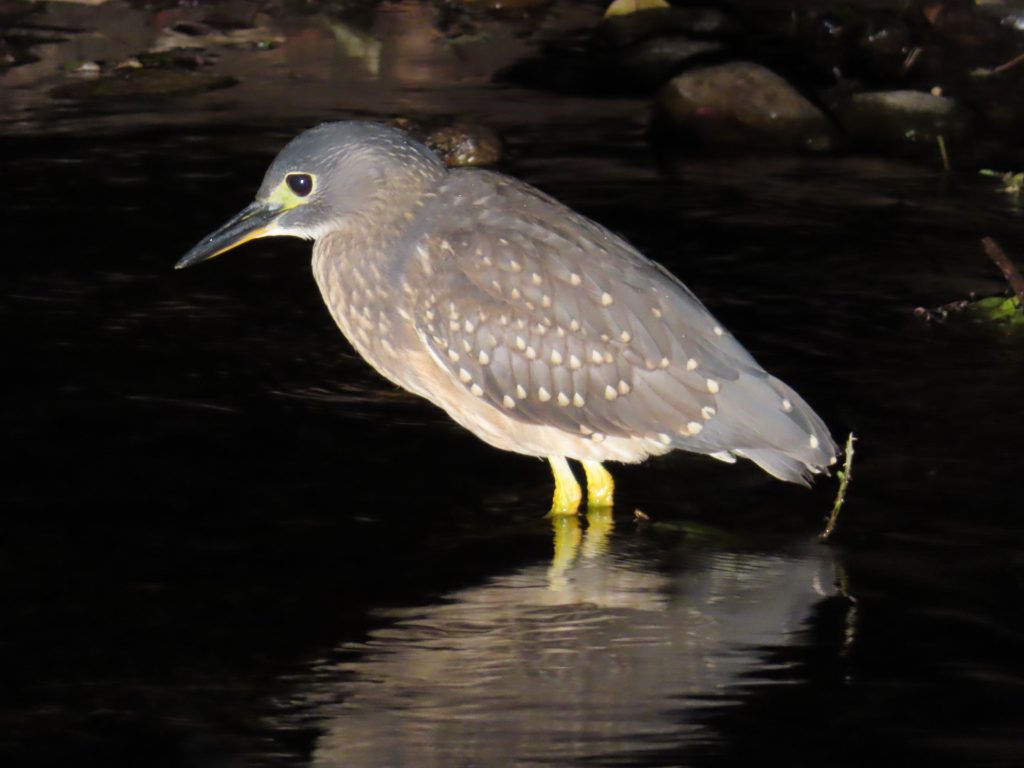
A juvenile White-backed Night Heron photographed at Mountainlands
You never know what the darkness will reveal when travelling through Mountainlands at night. Last night, an ordinary drive turned into an extraordinary wildlife encounter.
There, standing quietly in a shallow stream crossing, illuminated by the vehicle’s headlights, was an unfamiliar bird. A quick reach for a camera captured a few precious images before it melted back into the shadows. The reward was remarkable: a juvenile White-backed Night Heron (Calherodius leuconotus natalensis) – a species listed as Vulnerable.
This is no common sighting. A 2015 regional assessment suggested that fewer than 1,000 mature individuals may occur in the region, though the species’ cryptic and nocturnal habits make accurate counts elusive. Adding the challenges associated with surveying nocturnal riverine birds, this estimate is considered uncertain, and the true population size may differ.
Formerly placed in the genus Gorsachius, the White-backed Night Heron is now recognised as Calherodius leuconotus following the taxonomic treatment of del Hoyo and Collar (2014). Two subspecies are known: C. l. leuconotus, of West Africa, and C. l. natalensis, which ranges from Cameroon south through much of eastern and southern Africa, including eastern South Africa.
Medium-sized and stocky, measuring 50–55 cm and weighing around 440 g, the adult heron is striking: black face and crown, grey-brown upperparts, and a bold white patch across the back. Its chestnut neck and breast fade to white on the belly, while large eyes are perfectly adapted for nocturnal hunting. Juveniles, like the one encountered, are browner, with white-spotted wings and streaked underparts.
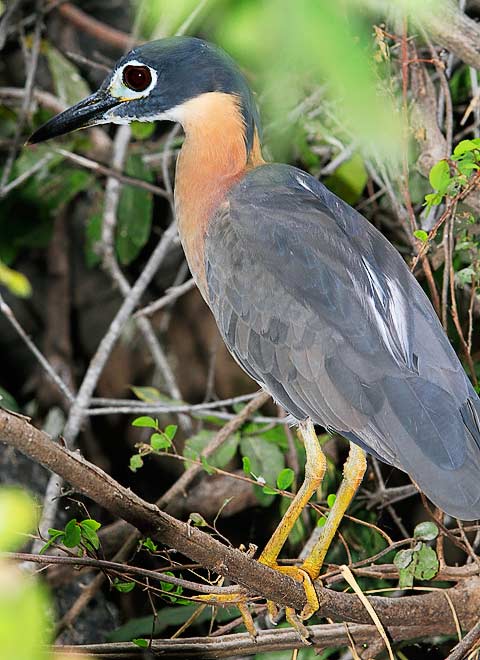
An adult White-backed Night Heron (photo. W. Tarboton)
This sighting is especially noteworthy because White-backed Night Herons are secretive, nocturnal birds that are seldom observed and remain poorly studied throughout much of their range. Observing one in the open is exceptionally fortunate. While the presence of a juvenile does not necessarily confirm local breeding, it does indicate that Mountainlands provides suitable habitat – underscoring the conservation value of its intact riverine ecosystems.
In southern Africa, this species occurs sparsely in low-lying, high-rainfall regions of eastern South Africa and Eswatini, extending westward along the southern coast to approximately Knysna in the Western Cape. Yet, its true distribution remains clouded in mystery, hidden by the bird’s secretive nature and the difficulty of surveying the species.
Encounters like this reminds us that even after dark, Mountainlands continues to reveal remarkable surprises and underscores the importance of protecting the wild habitats on which rare and specialised species like the White-backed Night Heron depend.