
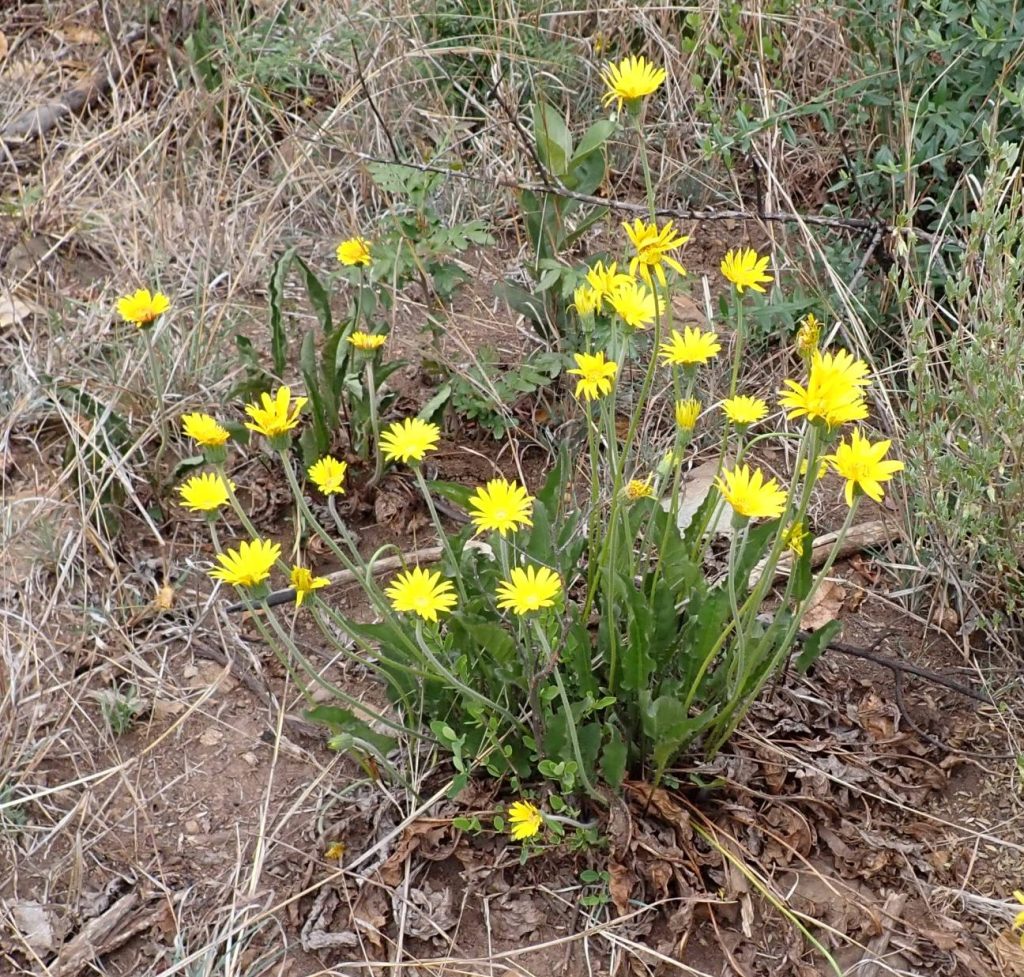
Gerbera serpenticola in its natural habitat.
A daisy species new to science has been documented in the Barberton area. Named Gerbera serpenticola, it grows in a small, hilly region north of the town. The formal description was published this week in the peer-reviewed South African Journal of Botany.
The plants were observed in November 2014 during a botanical field survey in the Jamestown Schist Belt, where the species coexists alongside South Africa’s famous Barberton Daisy (Gerbera jamesonii). Although a specimen was first collected as far back as 1962, it was mistakenly filed away in the National Herbarium in Pretoria as a standard Barberton Daisy. In the veld it went overlooked for decades due to its brief flowering window and highly specific habitat.
Now, Lowveld locals Delia Oosthuizen and Emeritus Prof. Kevin Balkwill from Wits University have formally described it as South Africa’s 18th recognized Gerbera species. Detailed comparisons with other yellow flowering Gerberas revealed that it did not fit cleanly with any known species. While it shares its native range with the classic Barberton Daisy which comes in different colours from red, coral to bright yellow flowers, several key differences set Gerbera serpenticola apart: unlike the typical flat, spreading petals of the classic Barberton Daisy, G. serpenticola features bright yellow flowers with upright petals that curve gently to form a distinct cup shape. Up close, its stems, leaves, and bracts are covered in soft hairs and tiny, burgundy-coloured, club-shaped glands. The plant is visibly smaller, featuring shorter leaf stalks and oval-to-spear-shaped leaves that lack the deeply lobed structure typical of G. jamesonii.
Unlike the Barberton Daisy, which occurs across a wide area and in various soil types, Gerbera serpenticola is a specialist endemic to the Barberton Centre of Plant Endemism. It grows exclusively on toxic, mineral-rich ultramafic (serpentine) soils within the Barberton Greenstone Belt – one of the oldest geological formations on Earth, dating back nearly 3.5 billion years. “We picked the species name, serpenticola, as it relates to the geology and combines the Latin words for ‘serpentine rock’ (serpentinus) and ‘dweller’ (-cola),” says Oosthuizen.
Gerbera serpenticola thrives in the rocky grasslands and wooded savanna of the Barberton Serpentine Sourveld, coming into full bloom between September and December.
Because Gerbera serpenticola has only been found within a very narrow geographic area, the botanists recommend placing it on the IUCN Red List as Endangered or Critically Endangered. Its survival depends heavily on protecting its fragile, hyper-specialized habitat in the hills north of Barberton.
This taxonomic project was made possible with seed support from the Botanical Education Trust, enabling the continued study of South Africa’s unique flora.