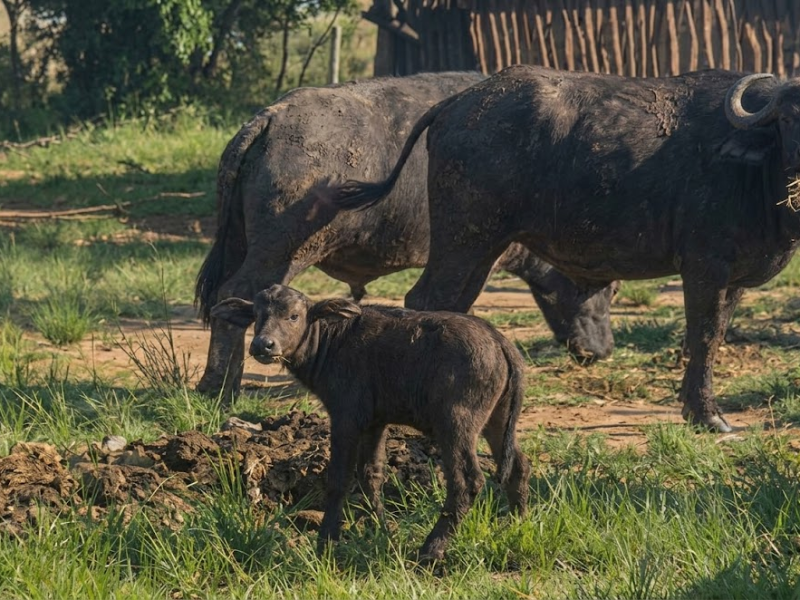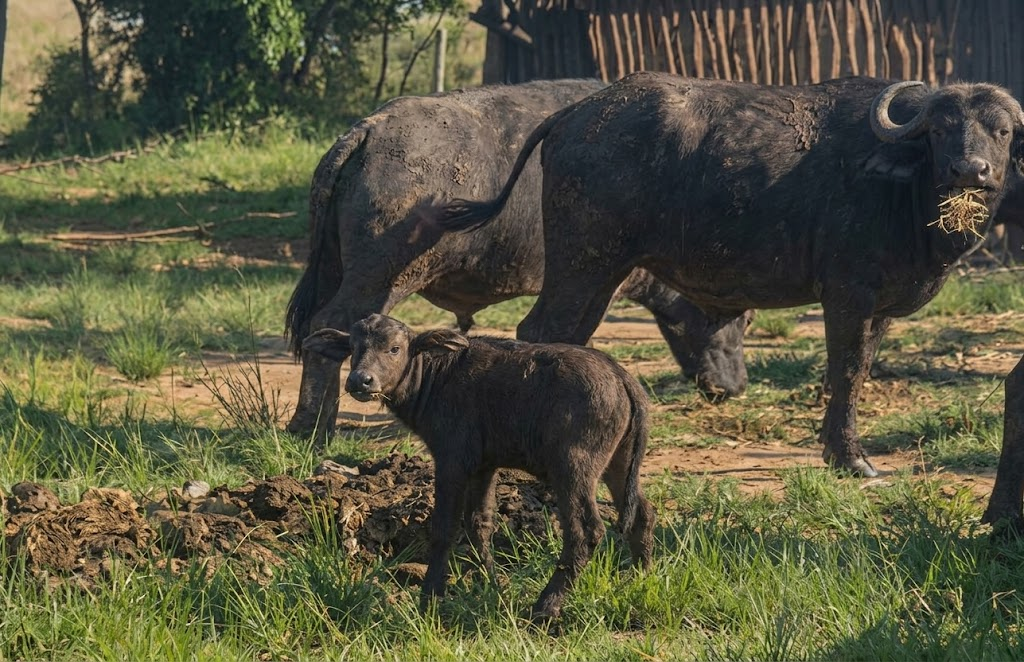
Wobbly-legged, wide-eyed, and tucked safely into the protective shadow of their mothers, two new arrivals at Mountainlands Nature Reserve are carrying a far heavier legacy than their small frames suggest. Born in the rugged, ancient hills just outside Barberton, these two Cape buffalo calves represent a joyful milestone in a conservation story that spans more than a century of loss, resilience, and recovery.
For the conservation teams and stewards of Mountainlands, the birth of these calves is cause for genuine celebration. When Cape buffalo were reintroduced to Barberton Nature Reserve in 2022, headlines announced their return after an absence of roughly 80 years – though historical records suggest these formidable grazers may have vanished from the immediate Barberton valleys even earlier.
To understand why two tiny calves, mean so much to this corner of Mpumalanga, one has to look back at how the species was erased from the region. In the late 19th century, the Barberton mountains were transformed by the 1880s Gold Rush. As thousands of prospectors flooded into the valleys, wildlife was heavily hunted to feed the booming mining camps, while expanding settlements and livestock fractured the wild terrain. It became so severe that in 1893, the eland, the rhinoceros, the giraffe and the buffalo became protected game, though with little law enforcement.
What unregulated hunting began, nature and human conflict nearly finished. In 1896, the devastating Rinderpest epidemic swept through southern Africa, wiping out up to 90 percent of the region’s cattle and cloven-hoofed wildlife, including Cape buffalo. Hot on the heels of the plague came the South African War (1899 -1902), during which armies living off the land further decimated whatever game remained.
By the turn of the 20th century, the great herds that once moved freely between the escarpment and the Lowveld were gone. To the first wardens of the newly proclaimed Sabie Game Reserve – the precursor to today’s Kruger National Park – the species appeared to survive only by a thread, with fewer than two dozen buffalo accounted for in the dense southern bush. Yet hidden pockets across the wider Lowveld and neighboring Mozambique had also weathered the collapse. Thanks to decades of dedicated protection and careful management, those surviving herds slowly recovered, eventually becoming the genetic lifeblood for conservation efforts across South Africa.
Yet, while buffalo thrived once more in the Kruger National Park, the steep, scenic valleys around Barberton remained without them for generations. Reintroducing them to Mountainlands Nature Reserve – a vital biodiversity hotspot nestled within the Barberton Makhonjwa Mountains World Heritage Site – was a carefully planned effort to restore the area’s natural ecological balance. As bulk grazers, buffalo play a crucial role in shaping grasslands, opening up dense vegetation, and creating healthier habitats for smaller wildlife.
Still, moving wildlife back into a historic range is only the first step; true success is measured when the animals settle in and begin to breed.
With the arrival of these two calves, the Mountainlands herd has officially put down roots. Watching the young ones stick close to their moms—learning to navigate the rocky slopes, getting to know the mountain grasses, and shelter under the watchful eyes of the herd – is a heartwarming reminder of nature’s capacity to heal when given the space and protection to do so.