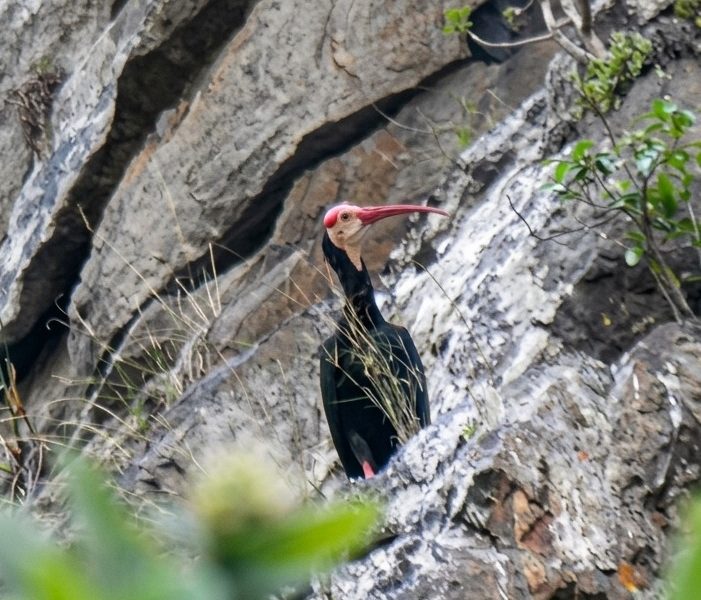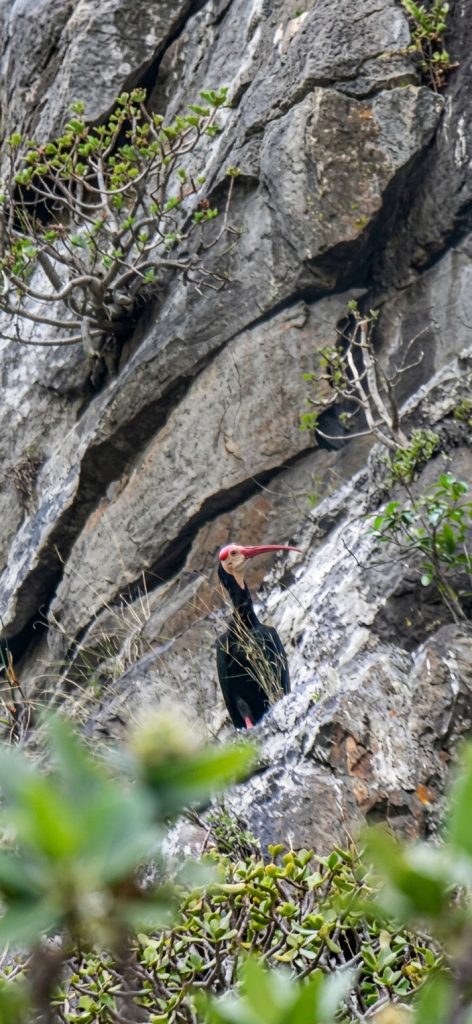
A Southern Bald Ibis on Mountainlands. Photographer: Gerson Schutte
A group of at least 11 Southern Bald Ibises (Geroniticus calvus) was recently spotted in one of the reserve’s dramatic gorges. Even more exciting, observers confirmed the presence of two active nests.
This marks an official first observation for Mountainlands, bringing the total count of threatened bird species recorded on the reserve to 16.
The Southern Bald Ibis is a large, striking bird easily distinguished by its unique, otherworldly appearance. Adults feature a bare, bright red crown, bill, and legs, contrasted against pale-white wrinkled skin on the face and neck. Its body plumage appears dark at a distance but flashes vibrant iridescent streaks of green, violet, and bronze in direct sunlight. Immature birds are duller and lack the vivid red coloration.
The species is strictly endemic to the Great Escarpment of southern Africa—spanning from the Limpopo Province down through Mpumalanga, KwaZulu-Natal, eastern Free State, and the Eastern Cape, as well as Lesotho and western Eswatini.
These birds prefer high-altitude, open, treeless mountain grasslands (typically between 1,200 and 2,000 meters above sea level). They show a strong affinity for short grass, recently ploughed fields, and freshly burnt areas where foraging is easy.
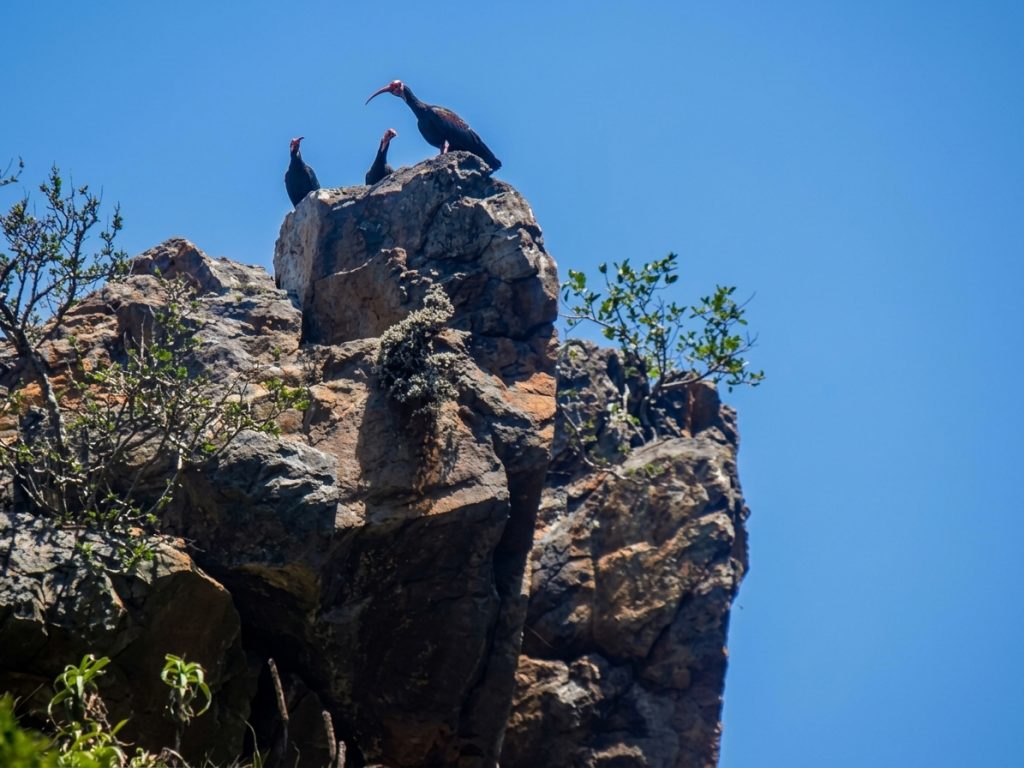
On top of the world: 3 Southern Bald Ibises on a rocky outcrop in the gorge. Photographer: Gerson Schutte
Southern Bald Ibises are largely resident birds, though they may disperse short distances after their breeding season wraps up between August and December.
They typically forage in small-to-medium flocks of 5 to 15 individuals (though gatherings of up to 100 birds occasionally occur). Probing the soil and snapping up prey with their long, curved bills, their diet consists of invertebrates such as grasshoppers, beetles, caterpillars (including maize stalk borers), earthworms, and snails, and vertebrates such as frogs, small mammals, small birds, and occasionally carrion.
The discovery of two nests in the gorge highlights the suitability of Mountainlands’ steep, sheltered terrain for breeding. They are monogamous and almost invariably nest in colonies ranging from 2 to 72 pairs. Placed on secure cliff ledges, potholes, or river gorges, the nest is a flimsy platform of sticks and branches collected by the male and assembled by the female, lined with finer plant material.
The egg-laying season runs from July to January, peaking between August and September to coincide with abundant post-burn foraging opportunities. Females lay 1 to 3 eggs, which both parents incubate for approximately 27 to 31 days. Both parents feed the chicks via regurgitation. Young birds take their first flight around 55 days of age and reach full independence about five days later.
Nesting chicks face natural predation from Jackal Buzzards (Buteo rufofuscus), Cape Eagle-Owls (Bubo capensis), Verreauxs’ Eagles (Aquila verreauxii), and Pied Crows (Corvus albus).
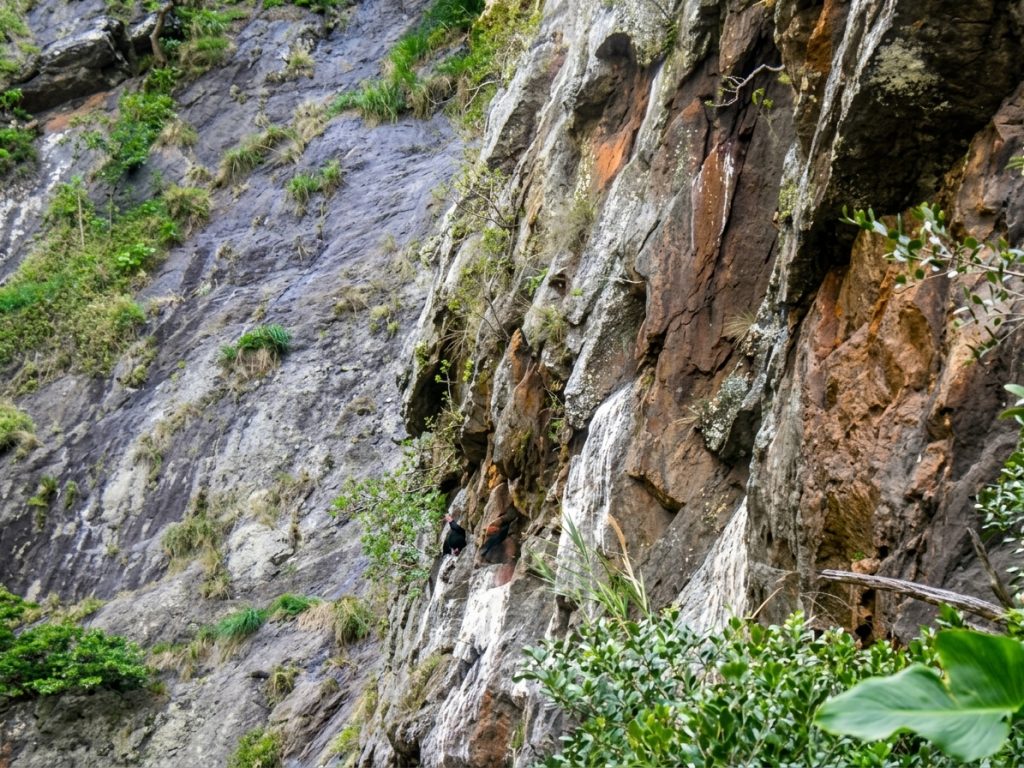
White streaks of their droppings against the cliff face indicate their popular hangouts. Photographer: Gerson Schutte
Currently classified globally as Near Threatened, the total world population of the Southern Bald Ibis is estimated at roughly 7,000 to 8,000 individuals (with broader estimates ranging from 5,000 to 10,000).
While the overall population has remained largely stable over recent decades with new colonies forming as old ones are abandoned, detailed habitat modelling predicts a potential 29% loss in suitable habitat over the next three generations. If loss of foraging and breeding areas is not offset by reproductive success, a future decline is anticipated.
Major threats include commercial afforestation, intensive agriculture, open-cast mining, and acid rain and human interference at sensitive cliff breeding colonies is noted as a disturbance.
The observation of nesting pairs at Mountainlands provides a welcome sanctuary for this endemic species—underscoring the vital role protected reserves play in safeguarding high-altitude grassland habitats and ensuring the long-term survival of southern Africa’s threatened fauna.